Driver guide · National edition
Published October 30, 2026 · TruckRescueNow driver guide bank, stamped October 2026
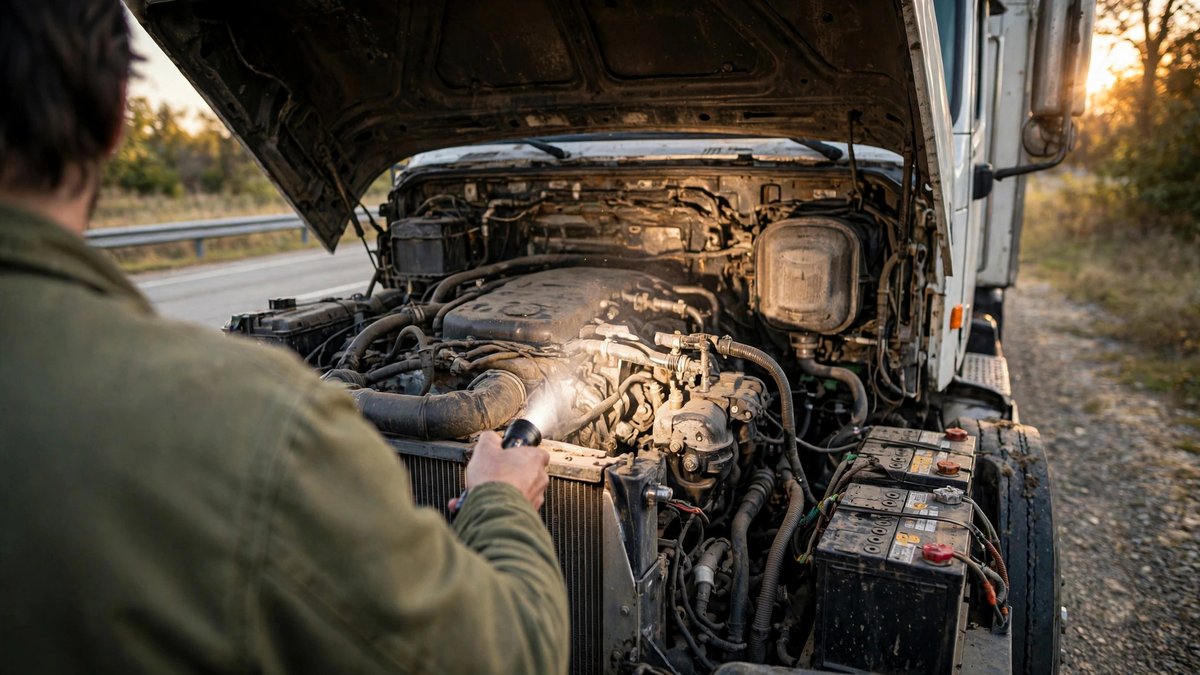
Batteries and connections first, then cranking behavior, then fuel, then the starter — a no-start is diagnosed by what the truck does when you turn the key, in that order.
"Won't start" is three different problems wearing one name
The check order follows cost: most no-starts are electrical and most electrical faults are connections, not components
Nothing at all, slow crank, or normal crank with no fire — each answer points at a different system.
Nothing at all: battery charge, a dead connection, or a failed switch/safety interlock
Slow, laboring crank: weak batteries, corroded cables, or a starter drawing too much
Normal crank, no start: the starter side is fine — now it is fuel or air to the engine
Terminals first: corrosion, looseness, and a cable you can twist by hand are the classic shoulder-side no-start.
A semi runs multiple batteries in a bank — one dead battery drags the whole bank down
Check the master disconnect switch position if your truck has one
Voltage at rest tells the truth a dash light does not: a bank that sat overnight with a load on it (lights, inverter, reefer cross-draw where fitted) is a known morning pattern
A truck that cranks normally but will not fire is starved or air-locked until proven otherwise: check the fuel level you actually have, the filter, and whether the primer pump is firm.
A recent filter change or a run-dry event leaves air in the lines (see the ran-out-of-fuel article in this series)
In cold weather, gelled fuel is the first fuel suspect (see the cold-start article in this series)
Do not crank in long bursts — you will add a starter and a dead bank to the original problem
When the connections are clean and tight, the bank is charged or jumped, and it still will not crank or fire — the fault is inside a component (starter, alternator-side, fuel pump) and that is a mechanic's diagnosis.
Cranking-system faults (batteries, starter) are a top-5 roadside system (TMC/FleetNet benchmarking) — service trucks carry the test gear for exactly this
Tell the dispatcher which of the three behaviors you have — "no crank," "slow crank," or "cranks, no fire" routes the call