Driver guide · National edition
Published October 30, 2026 · TruckRescueNow driver guide bank, stamped October 2026
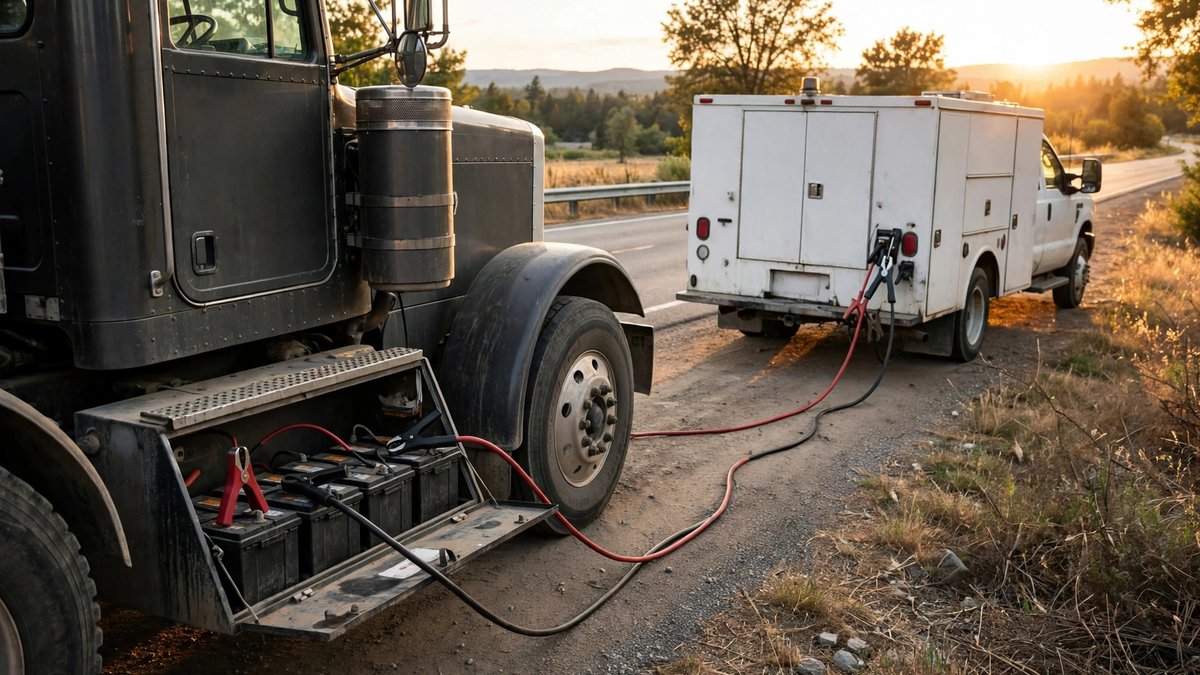
Age and history decide it: a healthy bank that was drained by a load takes a jump and a charge; an old bank, or one battery failed inside it, takes replacement.
A jump answers "can it start" — it does not answer "will it start tomorrow morning"
The test that decides: each battery load-tested individually after the jump, not the bank as a whole
When the cause is known and one-time: lights left on, a long sit with accessories running, an extreme cold night on a good bank.
Jump from a proper heavy-duty source — a service truck's jump pack or another truck, with correct cable order and a few minutes of charge before cranking
After it starts, the alternator needs real run time to refill the bank — a five-minute idle does not recharge a drained bank
If it cranks strong and holds charge on the drive, you bought time — schedule the bank test at the next shop stop anyway
When one battery in the bank has failed: it pulls the good batteries down to its level, and they all test weak together.
Batteries in a bank age together — a bank near end of life fails one member at a time, weekly
Swollen case, hot terminal, rotten-egg smell, or a battery that will not take a charge = replace, do not jump
Replacing one battery in an old bank is a short-term answer; matched-bank replacement is the standard fix
Jump or battery work on the roadside commonly lands in the $150–$400 band for common fixes, scaling with the number of batteries replaced (Albert's Road Service published rates).
The service call itself is the smaller half; batteries are the larger half
A repeat no-start the next morning costs a second call-out — the cheap decision at midnight can be the expensive one by morning
Kill the parasitic loads at shutdown: inverter, lights, and accessories off, and know what your truck draws parked.
Terminals clean and tight at every service — corrosion is a slow no-start being built
Cold weather cuts battery output while thick oil raises cranking demand — the winter double-hit is in the cold-start article in this series