Driver guide · National edition
Published October 30, 2026 · TruckRescueNow driver guide bank, stamped October 2026
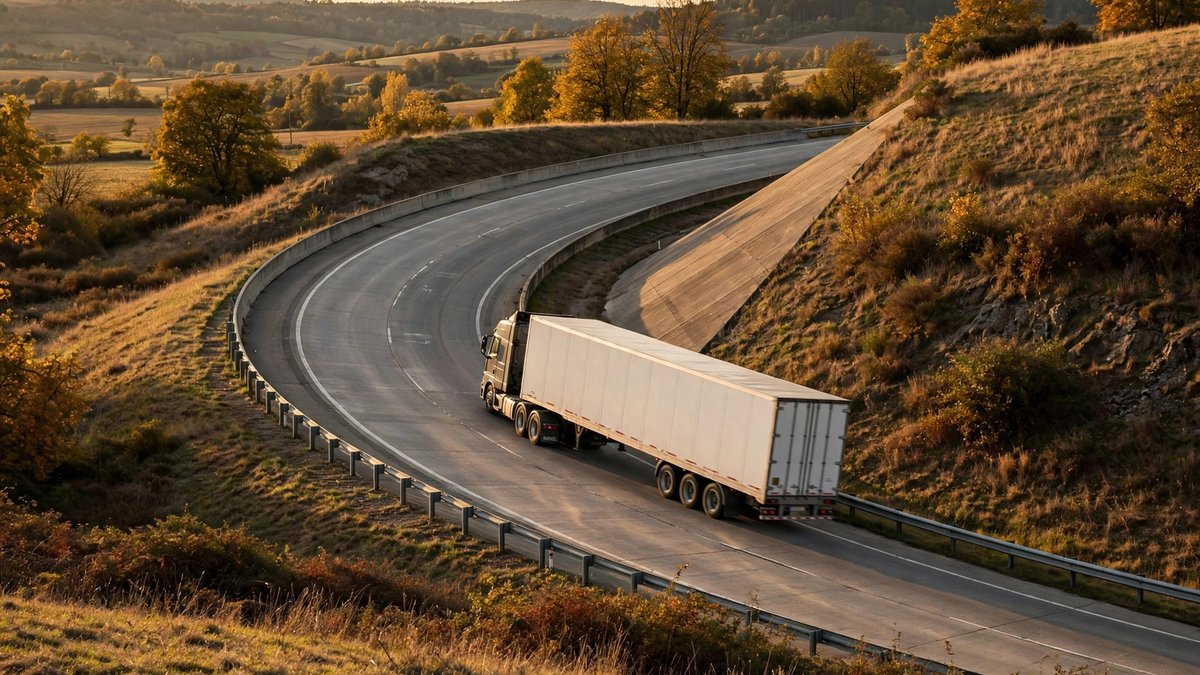
A semi rolls when sideways force overcomes a high center of gravity — and in most rollovers the truck was not speeding for the road, it was speeding for the curve, the ramp, or the load.
A loaded trailer's center of gravity sits high; the rollover threshold arrives at speeds drivers misjudge because the tractor feels stable
The trailer goes first — by the time the driver feels the roll, it is usually already decided
Too fast on ramps and curves, a shifting or top-heavy load, a sudden steering input (the swerve), soft shoulders and tripping, and wind on light or empty trailers.
Ramp speeds posted for cars are not truck rollover speeds — the advisory plate matters more than the limit
The swerve-and-recover is the classic sequence: dodge, then the correction rolls the trailer
A load that shifts mid-curve raises the center of gravity at the worst moment (see the load-shift article in this series)
Slow before the curve, not in it: all braking done straight, enter at a speed you could hold with one hand relaxed, and never brake hard mid-curve.
Read the ramp, not the car ahead of you — his speed is not your physics
Know your load's height and behavior: tankers surge, doubles wander, top-heavy freight leans — each gets a bigger margin
If a curve surprises you fast, ride it out smooth rather than stabbing the brake or sawing the wheel
A wheel dropped off the pavement edge is a rollover setup: do not yank back — slow nearly to a stop, then climb the edge at a shallow angle when traffic allows.
The yank-back is the trip mechanism: tires catch the edge, the trailer whips, the roll starts
For an obstacle ahead, braking straight beats swerving for almost every loaded combination — hit small, brake hard and straight, rather than roll avoiding it
Brakes in adjustment, tires at pressure, and suspension intact are rollover prevention — a truck that leans, pulls, or bounces enters the curve already compromised.
Underinflated tires flex and let the trailer sway build
Out-of-adjustment brakes make the straight-line braking before the curve uneven and longer
The pre-trip is the prevention program; there is no technology in the cab that out-drives it