Driver guide · National edition
Published October 30, 2026 · TruckRescueNow driver guide bank, stamped October 2026
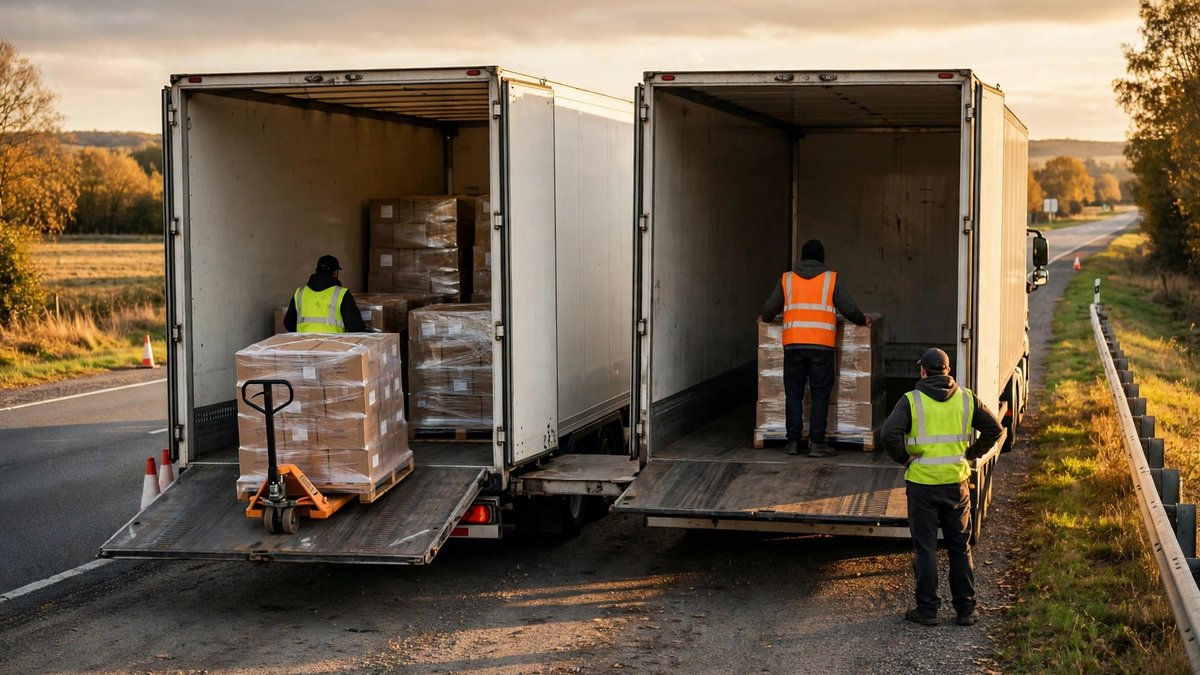
Separate the freight's emergency from the truck's emergency: the load transfers to another trailer, or another tractor pulls your loaded trailer onward, while your truck gets repaired on its own clock.
Every breakdown system treats the event as a vehicle problem; a loaded truck is also a cargo problem with its own dollar clock
The question "how does the freight deliver?" has an answer that does not wait for your engine
When the repair is long or unknown (engine, transmission, major component), the load is time-sensitive or refrigerated, or the delivery penalty costs more than the transfer.
A reefer load warms on the repair's schedule, not the customer's (see the reefer article in this series)
A short repair — a tire, a battery — never needs a rescue; rescue is priced against the long tail of repairs
Fleet dispatchers run this play as a "rescue unit"; owner-operators must ask for it by name
The rescue tractor or trailer meets yours at a workable location — a dock, a yard, or a wide lot near the nearest exit — and the freight moves by forklift or the whole trailer swaps tractors.
A tractor swap (your trailer, their tractor) is the fastest version: no freight handling, seals stay intact
A freight transfer is the heavier version: equipment, labor, and a re-securement job on the receiving trailer
Seals and counts are documented at the handoff — the chain of custody is part of the service, not an extra
It is priced as its own job — a unit dispatched plus handling where freight moves — and it is normally a carrier/shipper-side cost decision, made by whoever owns the delivery penalty.
Compare it against the true alternative: downtime at $448–$760 per day in lost hauling alone (ATRI, via Heavy Duty Journal), plus the late load, plus the reefer risk
The decision belongs to dispatch and the customer together; the driver's job is raising it early, while it is still cheap
Raise the load question in your first call, not your fourth: "the truck may be down long — what is the plan for the freight?"
Keep the trailer secure and the seal intact; photograph the seal and the load's visible condition
Do not authorize transfers of freight on your own signature if you are a company driver — the chain of custody must start with dispatch