Driver guide · National edition
Published October 30, 2026 · TruckRescueNow driver guide bank, stamped October 2026
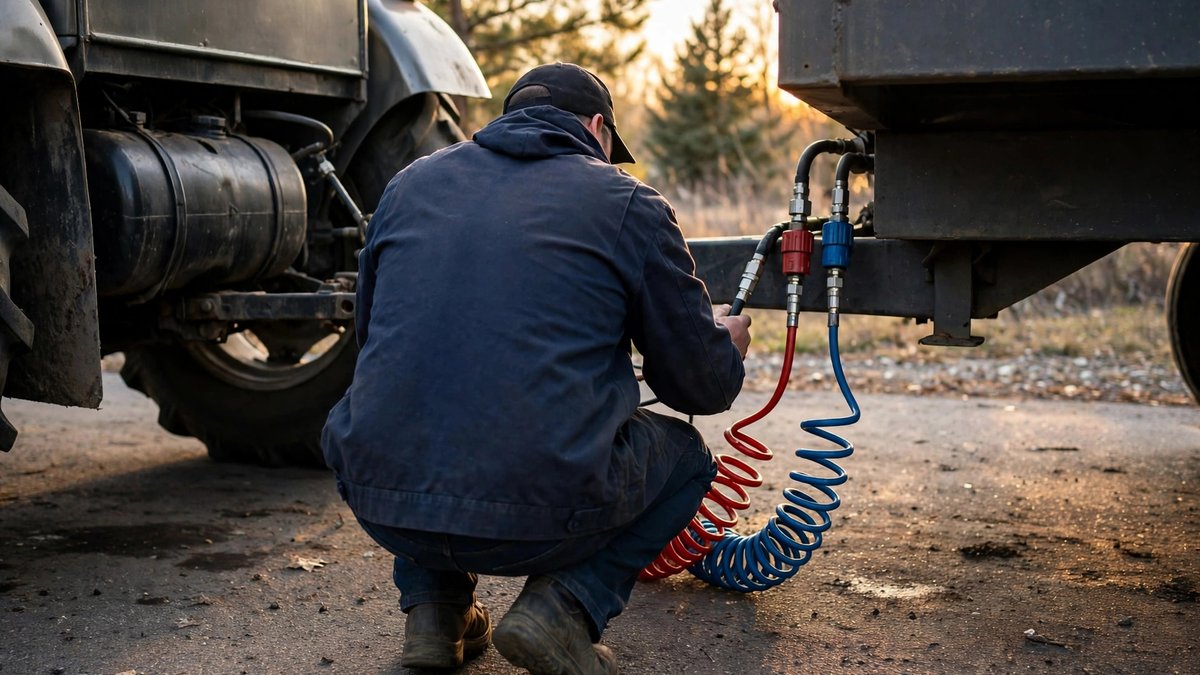
The air connection between tractor and trailer: both gladhands seated and sealed, both lines un-kinked and un-damaged, and air actually reaching the trailer.
Most "no trailer brakes" events are connection events, not brake events
The blue (service) line carries your brake applications; the red (emergency/supply) line keeps the trailer's spring brakes released and its tank charged
Crossed lines produce a trailer that behaves wrong in both directions — reseat and re-check before condemning components
Trailer brakes that never apply: no service air reaching the trailer, or a failed relay valve. Trailer brakes that will not release: supply air is missing, or the trailer's spring brakes are doing exactly their job with no air to hold them off.
A trailer that pushes the tractor on stops is reporting weak or absent trailer braking
One hot wheel and the rest cold: the problem is at that wheel end — chamber, slack adjuster, or a kinked line to it
Trailer brakes dragging and smoking: a brake that did not release — heat at that wheel is the tell (see the air-brake signs article in this series)
Gladhand seals (a missing rubber seal leaks the application away), visible line damage, the trailer tank drain for water, and — with the brakes applied by a helper or a held pedal — listening at each wheel for air and movement.
Check that the trailer's air tank is charged: a trailer that sat uncoupled for days may need minutes of tractor air before its brakes behave
Confirm the trailer ABS lamp behavior — a lit trailer ABS lamp is itself an inspection violation and a diagnostic clue
Relay valves, chambers, slack adjusters, and ABS modulators are the repair tier — mobile brake work, done where the trailer sits.
Brakes and air are 12% of all trailer road calls (FleetNet America) — this is stocked, standard road service
A trailer with no working brakes is not a "drive it carefully" vehicle: the combination's stopping system is designed around both units braking
Tell the dispatcher which symptom you have — never apply, won't release, or one wheel — each routes different parts
Brake defects are the most common vehicle violations and a leading out-of-service cause — a trailer brake fault found at a scale is a repair-before-you-roll order (see the out-of-service article in this series).
Finding it yourself, here, costs a service call; having it found for you costs the call plus the citation plus the CSA points